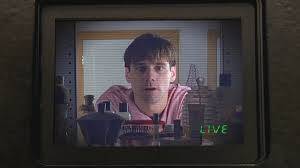
Released in 1998, Jim Carrey films in this movie that is unlike most of his work. Carrey is recognizable for his grand, dramatic facial expressions, which usually serve as a comedic relief in many light-hearted films. In The Truman Show, the audience is witnessing a man's fabricated world fall apart around him as he spirals mentally to a point of near madness. Carrey's performance is exepetionally well-done, and has since made me wish that he starred in more films with this type of vibe.
The film follows Truman Burbank (Jim Carrey), an affable insurance salesman who lives in the picture-perfect seaside town of Seahaven. His life appears idyllic: he is surrounded by cheerful neighbors, married to a loving wife, has a loyal best friend, and walks the streets under skies that are always sunny. But from the opening scenes, there’s already something off, even if Truman does not notice at first. He's been raised in this fabricated suburbia fantasy, with no reason to question what has been his entire life. The audience can see an artificial polish to every interaction. Truman's neighbors repeat the same lines, his wife awkwardly performs product placements mid-conversation, and there is a strange sense of surveillance that Truman clearly can’t quite put his finger on. It's when a studio light labeled “Sirius” falls from the sky, the illusion starts to crack.
As Truman’s suspicions grow, so does his emotional turmoil. Every one of his sattempts to leave Seahaven is blocked. There's traffic jams appearing out of nowhere, bus routes that suddenly break down, and even the radio that seemingly reads his thoughts. The more he notices the inconsistencies, the more paranoid he becomes, but that paranoia isn’t unfounded. The audience knows what Truman doesn’t: he’s been the unwitting star of a reality show since birth, his entire world a soundstage and his relationships scripted. The cruel genius of the story lies in how intimately the film lets us experience his disorientation. We’re not just watching a man trapped on an island; we’re watching his sanity get tested in real time, and we're along for the ride with him.

This is where the movie’s undercover identity as a psychological thriller comes alive. Every moment Truman senses the truth but can’t prove it leads to a small psychological breakdown. His wife’s forced cheerfulness becomes menacing. His best friend’s reassurances feel like gaslighting. The tone of the film shifts from curious and comedic to this suffocatingly tense nightmare as Truman’s world becomes less a quaint suburb and more a maze designed to keep him placid, as he is their star. His world is their stage, yet he'd been none the wiser.The manipulation of his mind, moreso than the technology of the dome, forms the movie's real conflict for Truman.
By the end, the film builds to its unforgettable climax: Truman finally escapes Seahaven and reaches the edge of his world. His sailboat literally hits the wall of the man-made sky, which serves as a sense of closure for Truman that he'd not been so crazy after all. Even with Truman's acceptance that he'd been right with his suspicions, the audience can't help but feel perturbed with the concrete information of what we'd realized all along. Standing before the exit door, illuminated with a blinding light, he must decide whether to step into an unknown, potentially dangerous reality or remain in the safety of the only world he’s ever known that'd been crumbling before him. His brief farewell, followed by his decision to walk through the door, is a subtle act of rebellion as he rejects the surrealism.
It’s far more psychological thriller than lighthearted social satire, because what Truman endures isn’t funny; instead it’s a complete unraveling of his sense of reality. InThe Truman Show, the ultimate tension isn’t between man and machine, or about celebrity and privacy, but it's actually between belief and truth. The real horror isn’t that Truman was filmed. It's that his entire perception was a lie.
I think it's instinctual for the audience to want to see what happened after Truman crossed that threshold. To uphold the entire point of the film, though, I'm fortunate that it's relatively open-air. And I'm also fortunate that as much as I love this movie, there has never been a sequel and it's understood that this installment does not necessitate one. Yes, The Truman Show is central to Truman's own unraveling, but there is a beauty in the audience not knowing any more about Truman's fate than he does. It's kind of like this twist on things, that we're left with only what we thought we knew just as Truman was.
Add comment
Comments